Refunds with receipts.
ClaimSight is an after-sales teammate. It reads the customer's evidence video, applies your refund policy, executes the refund itself, catches returns fraud across accounts, and hands the manager a 3D receipt rendered in Blender.
- Customer
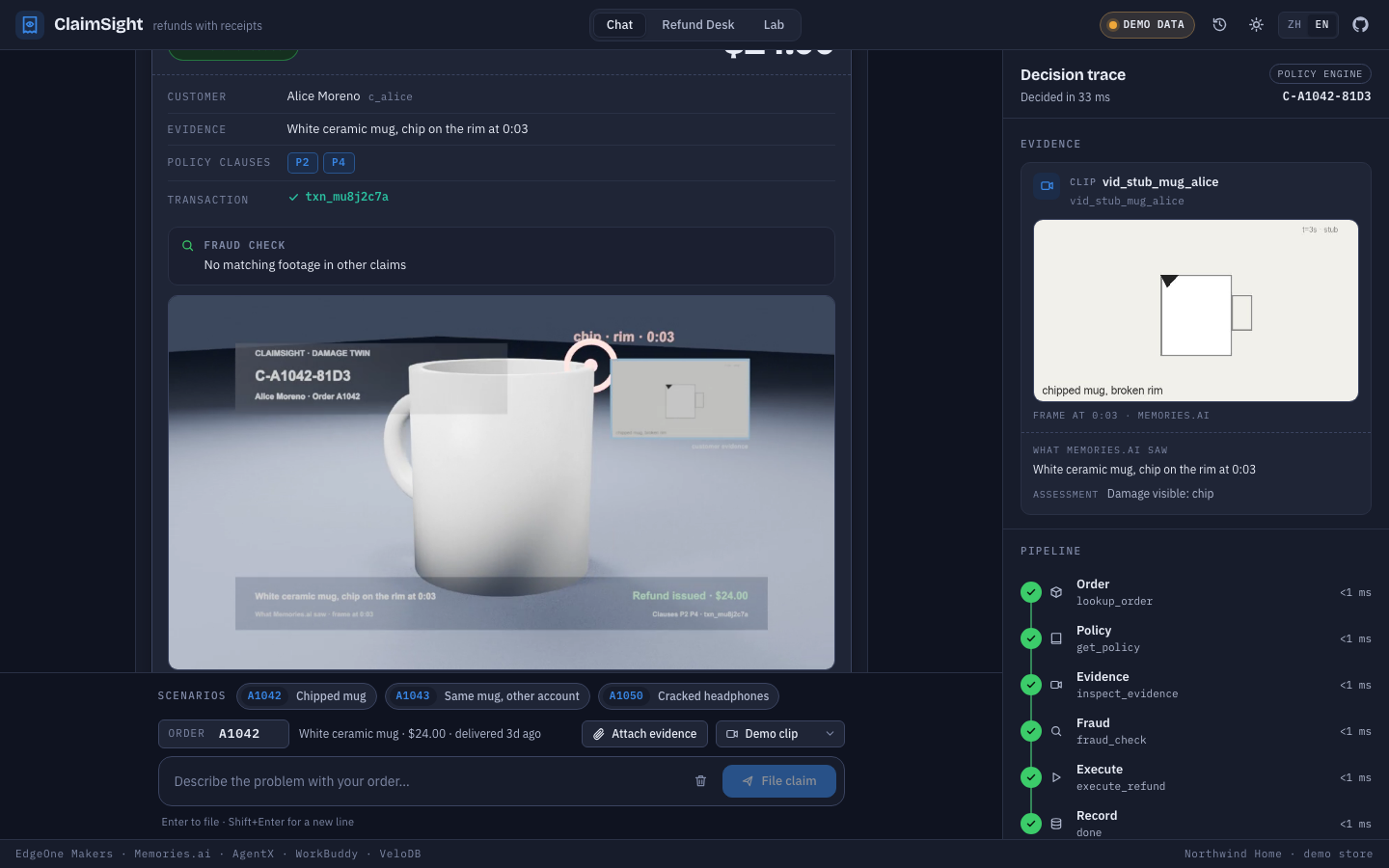
- Alice Moreno · Order A1042
- Evidence
- White ceramic mug, chip on the rim at 0:03
- Policy
- P2P4
- Transaction
- txn_mu8j2c7a
- Fraud check
- No matching footage in other claims
A chipped mug. A refund. A fraud catch.
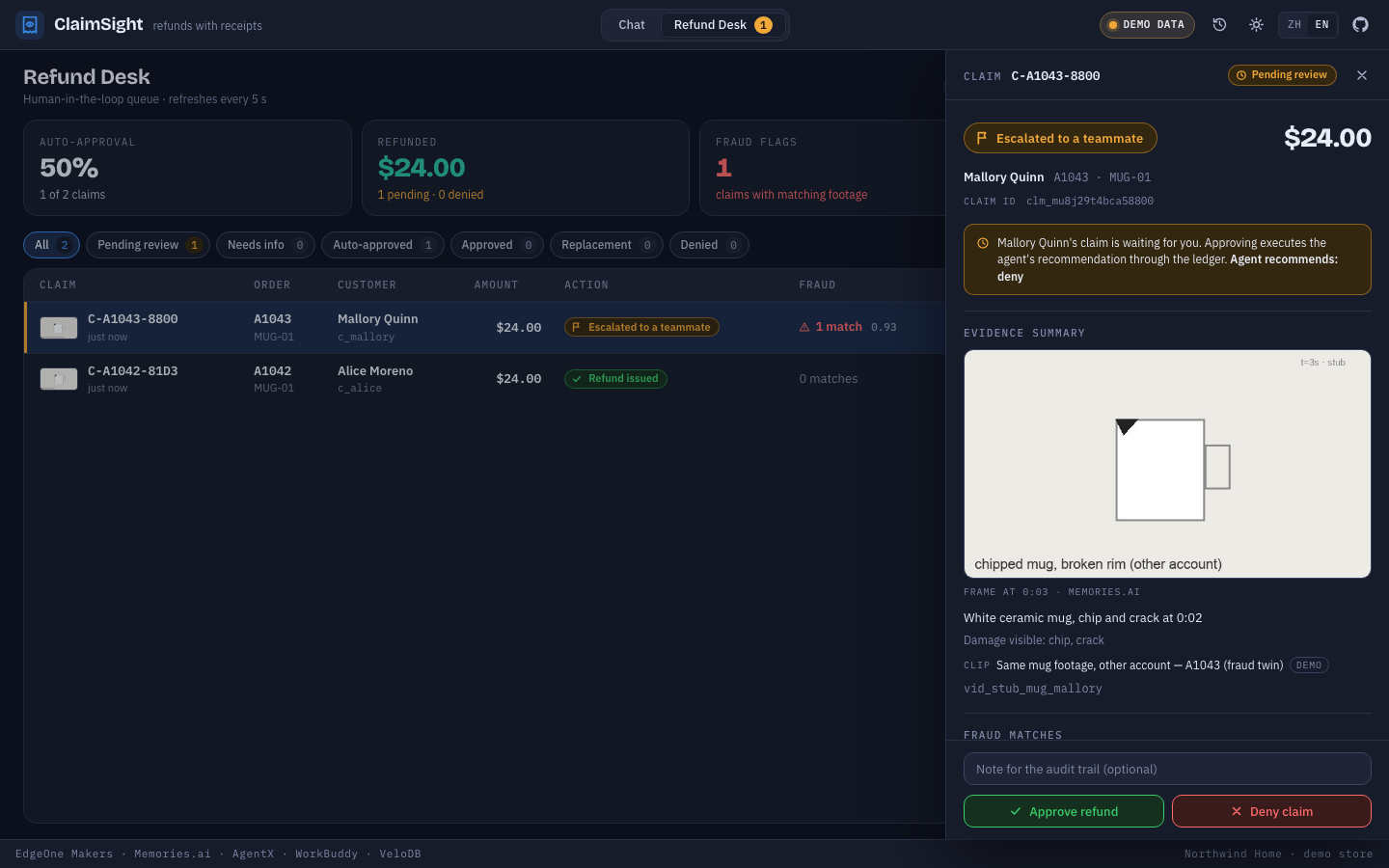
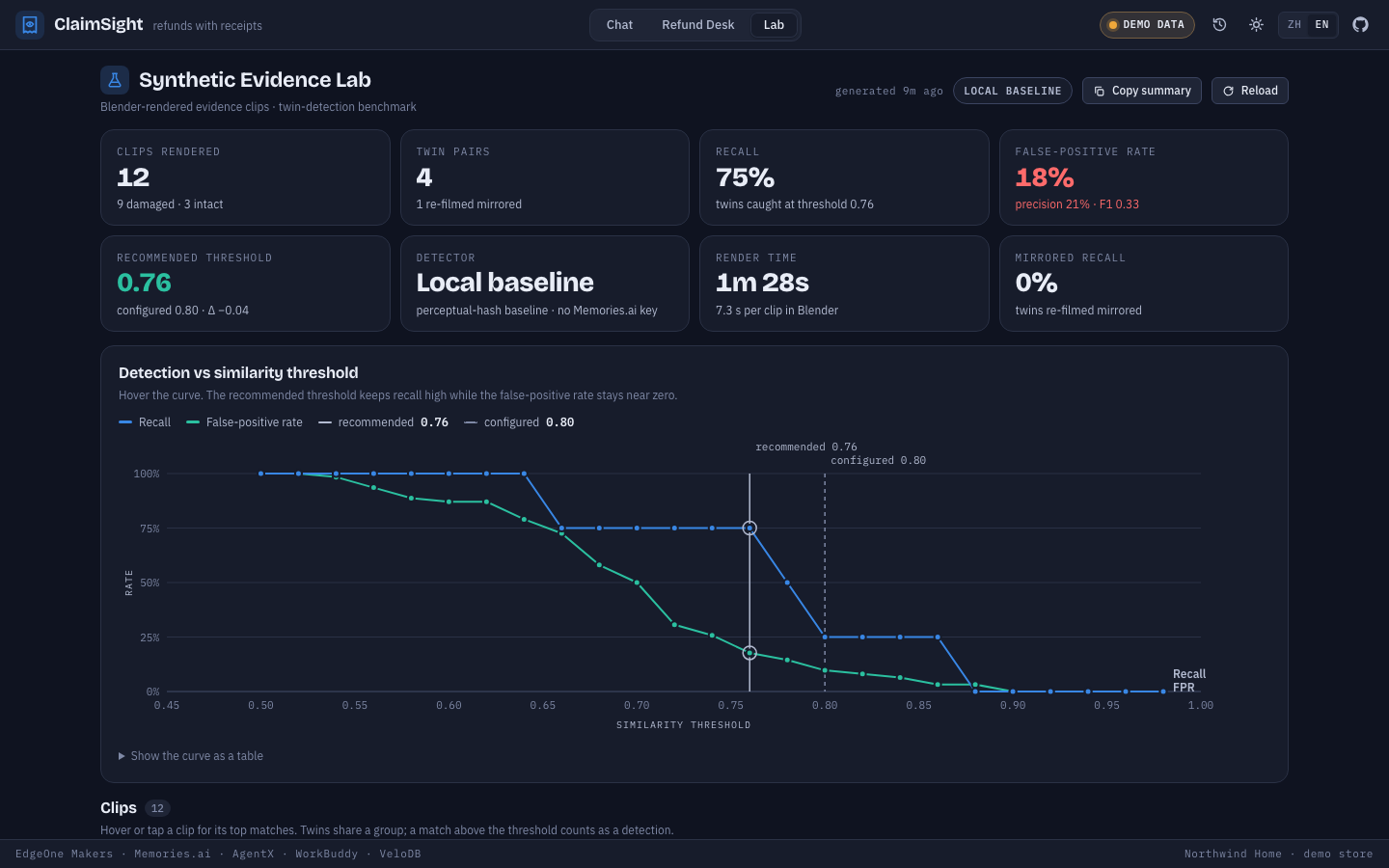
A real run against the app: claim filed, refund issued with a transaction id, the Damage Twin renders into the card, the fraud twin is frozen, the manager denies it with an audit note, and the Synthetic Evidence Lab shows how the detector was measured.
One loop, from evidence to ledger entry.
Most assistants stop at an answer. ClaimSight reaches the last layer of the event's thesis: a transaction with a receipt.
Video + order
A 10-second clip. Orders and policy are structured JSON on EdgeOne Makers. No vector database.
See the damage
The clip becomes captions and frames; its frames are searched against every prior claim for a twin.
Decision Card
Streaming chat shows the reasoning, the cited clauses, the evidence line and the transaction id.
Policy, twice
The agent applies it; the refund service enforces it again. Over the limit or suspicious? A human in Slack.
Refund issued
Ledger entry, decision record, a trace in AgentX, and a Blender-rendered Damage Twin as the receipt.
Built like a teammate, shipped like software.
Reads the evidence
Captions, frames and a summary become the claim's evidence record: "white ceramic mug, chip on the rim at 0:03."
Policy enforced twice
Clauses P1–P6 are cited by the agent and re-checked by the refund service. The model cannot exceed policy even when asked.
Executes the transaction
Refund or replacement, written to the ledger with a transaction id. Above $75 or on a fraud signal, a human decides.
Catches the fraud twin
Before paying, a frame from the new clip is matched against every prior claim. Same footage from another account freezes the claim.
Damage Twin receipt
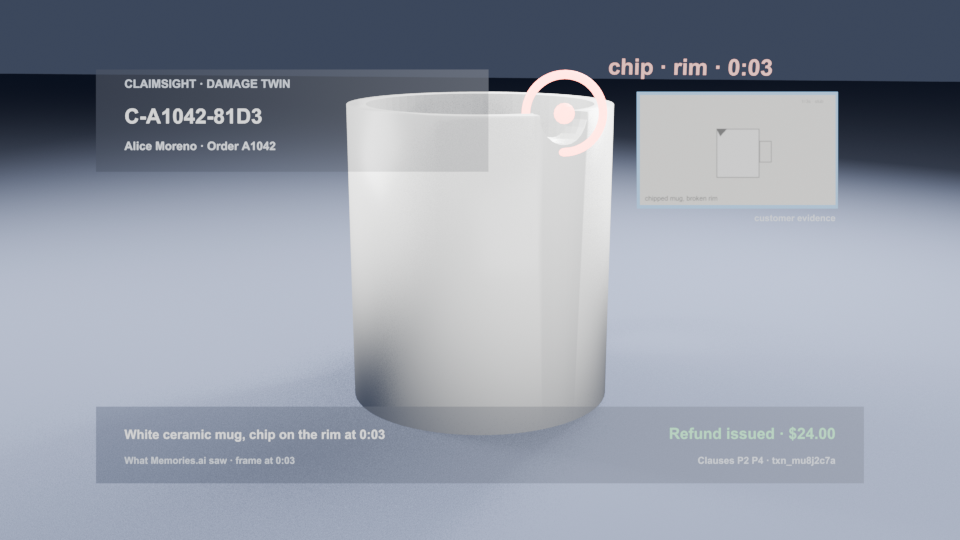
Blender renders a 3D twin with the damage marked where the video showed it, composited with the customer's frame and the decision.
Proven, not promised
31 golden claims, a policy judge, a deploy gate that fails on regression, PII and secrets monitors, one trace per claim, and a synthetic-video lab.
The card, the desk, the lab.
Numbers from the build, not the pitch.
The receipt you can orbit.
Every decided claim gets a 6-second Blender render: a procedural twin of the product, a pulsing marker where the damage was described, the customer's frame and the decision as a HUD. It plays inside the Decision Card and the manager's drawer, and it rides along with the escalation.